
In 30 seconds
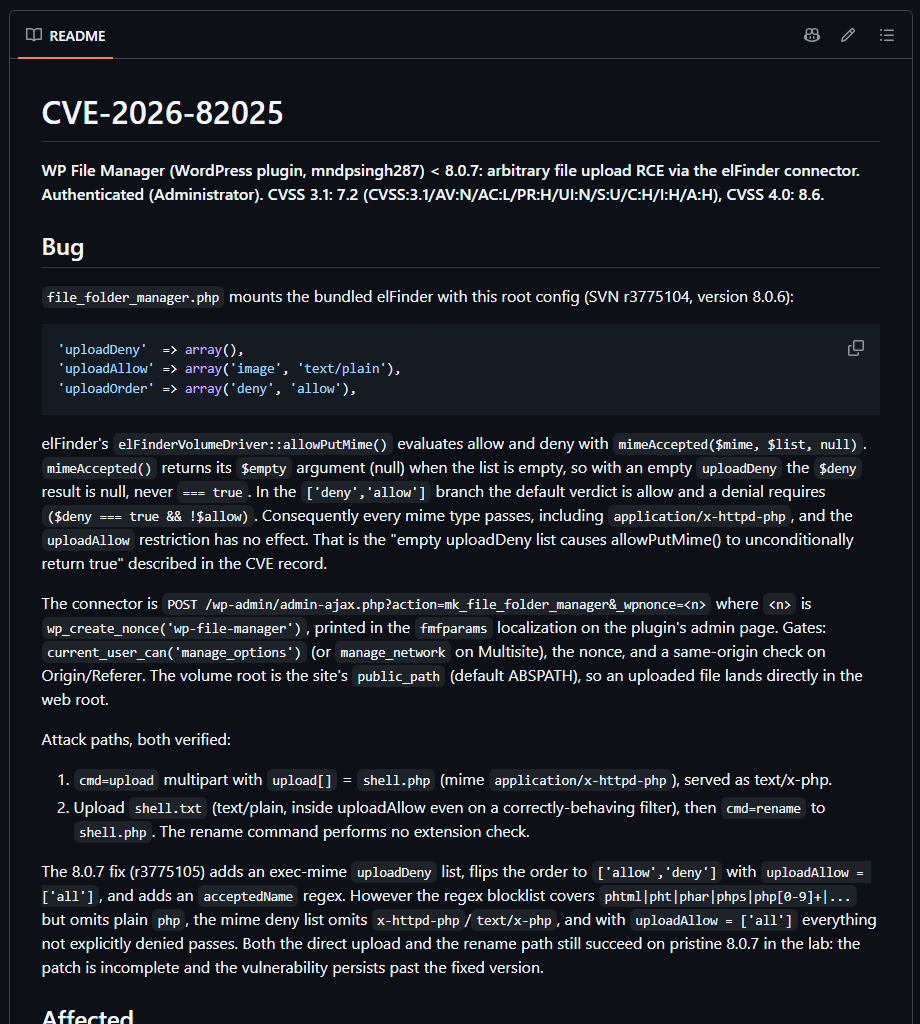
Proof-of-concept exploit code for CVE-2026-82025 is now public on GitHub, and it targets a familiar name: WP File Manager, a WordPress plugin for managing site files. DarkWebInformer's write-up rates the flaw at 7.2 on the CVSS severity scale, high, and lists version 8.0.7 as the fixed release. The short version: update first, read the details after.github.comgithub.com · rssOpen original sourceSee in source listDarkWebInformerx.com · DarkWebInformer · xOpen original sourceSee in source list
According to that write-up, the bug lives in the plugin's elFinder connector, the component that handles file operations. A misconfigured uploadDeny list, the blocklist that filters which file types can be uploaded, lets any logged-in administrator push a PHP file onto the server, or upload an allowed file and rename it to .php. The result is remote code execution, which in plain terms means running commands with the web server's privileges.DarkWebInformerx.com · DarkWebInformer · xOpen original sourceSee in source list
What happened
The sequence is short. A GitHub user under the handle rxsklife published a repository named CVE-2026-82025 containing the proof-of-concept. DarkWebInformer then posted a detailed breakdown on X, pairing the technical summary with a screenshot and a direct link to the PoC.github.comgithub.com · rssOpen original sourceSee in source listDarkWebInformerx.com · DarkWebInformer · xOpen original sourceSee in source list
Per that breakdown, the vulnerable component is the elFinder connector in WP File Manager versions below 8.0.7. The attack is remote, it requires an authenticated administrator, and it ends with code execution as the web server user. The flaw is classified as CWE-434, unrestricted upload of a file with a dangerous type.DarkWebInformerx.com · DarkWebInformer · xOpen original sourceSee in source list
Why it matters
A flaw like this matters because of where it ends: remote code execution on the server hosting the site. The advisory scores it 7.2, high, precisely because an attacker who reaches the end of the chain controls what the web server controls.DarkWebInformerx.com · DarkWebInformer · xOpen original sourceSee in source list
The mitigation is the authentication wall. Only administrators can trigger the bug, so it cannot be scanned across the internet at scale the way unauthenticated WordPress plugin flaws often are. The practical risk concentrates on sites where admin accounts are weak, shared, or already stolen, since a hijacked admin session turns this into a full server takeover.DarkWebInformerx.com · DarkWebInformer · xOpen original sourceSee in source list
What to do
The primary action comes straight from the advisory: update WP File Manager to version 8.0.7 or later, the release listed as fixed. Sites on older versions remain exposed to anyone who combines the public PoC with an administrator account.DarkWebInformerx.com · DarkWebInformer · xOpen original sourceSee in source list
Secondary defenses follow from the attack path. Harden administrator logins with strong passwords and two-factor authentication, prune accounts that no longer need admin rights, and audit uploads for unexpected .php files in case the bug was probed before the update.DarkWebInformerx.com · DarkWebInformer · xOpen original sourceSee in source list
Confirmed and still uncertain
Established so far: the PoC repository is live, the affected range is every WP File Manager release below 8.0.7, the fix is version 8.0.7, and the reported severity is CVSS 7.2.github.comgithub.com · rssOpen original sourceSee in source listDarkWebInformerx.com · DarkWebInformer · xOpen original sourceSee in source list
Reported but unverified: DarkWebInformer states there are no confirmed cases of in-the-wild exploitation and that the CVE does not appear in CISA's Known Exploited Vulnerabilities catalog.DarkWebInformerx.com · DarkWebInformer · xOpen original sourceSee in source list
Genuinely unknown: how many sites run vulnerable versions, whether anyone has quietly probed the flaw, and whether attackers will pick up the public PoC now that it is one clone command away.DarkWebInformerx.com · DarkWebInformer · xOpen original sourceSee in source list
What people are saying
DarkWebInformer is the main public voice so far, framing the bug as an upload restriction bypass leading to remote code execution, listing CVSS 7.2 and CWE-434, and explicitly cautioning that exploitation is not yet confirmed.DarkWebInformerx.com · DarkWebInformer · xOpen original sourceSee in source list
The researcher behind the PoC, who publishes as rxsklife on GitHub, has not added commentary within our evidence batch; the repository itself is the statement.github.comgithub.com · rssOpen original sourceSee in source list
Evolution
The timeline is compressed: the write-up and the exploit code surfaced together in public channels, meaning offensive tooling was available from day one of the disclosure.github.comgithub.com · rssOpen original sourceSee in source listDarkWebInformerx.com · DarkWebInformer · xOpen original sourceSee in source list
Since then the picture has held steady, with no KEV listing and no incident reports in the evidence. The likely next inflection points are a CISA KEV entry, the first confirmed victim, or a vendor advisory with more detail on the misconfiguration.DarkWebInformerx.com · DarkWebInformer · xOpen original sourceSee in source list
Reach
1 independent groups, 1 updates, and 1 engagements.
Technical detail
The mechanics, as described: WP File Manager bundles elFinder, an open source file manager library, and exposes a connector that processes uploads. In vulnerable versions the connector's uploadDeny list, which is supposed to reject dangerous file types, is misconfigured. An administrator can upload a PHP file outright, or upload a permitted file type and rename it to .php from inside the file manager, and the web server then executes the script.DarkWebInformerx.com · DarkWebInformer · xOpen original sourceSee in source list
The write-up classifies the bug as CWE-434, unrestricted upload of a file with a dangerous type, with a CVSS base score of 7.2, high. Exploitation is remote and requires an authenticated administrator session, which shapes both the scoring and the practical risk.DarkWebInformerx.com · DarkWebInformer · xOpen original sourceSee in source list
Sources and evidence
This item rests on two artifacts: the public GitHub repository rxsklife/CVE-2026-82025 holding the proof-of-concept code, and DarkWebInformer's post on X carrying the technical breakdown, severity metrics, and a screenshot of the advisory details.github.comgithub.com · rssOpen original sourceSee in source listDarkWebInformerx.com · DarkWebInformer · xOpen original sourceSee in source list
Notable gaps: no vendor advisory, no NVD or CVE record text, and no independent reproduction appear in the evidence batch. Every technical claim currently traces to a single write-up plus the PoC, so the mechanics should be read as researcher-reported until the vendor or a second researcher confirms.github.comgithub.com · rssOpen original sourceSee in source listDarkWebInformerx.com · DarkWebInformer · xOpen original sourceSee in source list
Sources
- github.comgithub.com · rss
- DarkWebInformerx.com · DarkWebInformer · x