Maximum-severity GitLab flaw became an AI exploit in 17 minutes
AI turned the GitLab advisory into a working exploit in minutes, while PHP was already being exploited before the patch.
The 30-second summary
- Maximum-severity GitLab flaw allows intrusion without a password; a researcher with no experience built a working exploit with AI in 17 minutes.
- PHP2Shell was already under attack before the patch, Amazon says; 25% of the flaws exploited in 2026 had an attack on the day of the announcement.
- Ransomware published Whirlpool data, owner of Brastemp and Consul; the attack is by the WhiteArmor group.
- Incident on the Railway platform: customer secrets may have been read, some already decrypted; rotate credentials immediately.
- VirusTotal flagged 6.6 thousand AI agent skills as malicious; most have no virus, only text instructions.
Maximum-severity GitLab flaw allows code execution without a password

GitLab fixed a maximum-severity flaw, scored 10 out of 10, that allows running commands on the server without a password. It affects installations that companies host themselves, covering 12 years of versions. The official gitlab.com service is already patched.
A researcher with no exploit experience used the Gemini AI to turn the official advisory into a working attack in 17 minutes, and completed the chain in one hour. GitLab servers hold source code and deployment credentials: breaking into one compromises everything it delivers.
For the technical team
CVE-2026-110264: integer overflow in the regular expression compiler allows unauthenticated RCE via a malicious regex (CVSS 10.0, AV:N/AC:L/PR:N/UI:N/S:C). The same release fixes CVE-2026-15723, account takeover via OmniAuth/LDAP, and cache poisoning in OAuth/OIDC. Discovery credit: @joaxcar. There are prerequisites for exploitation, but the patch urgency remains.
- CVE
- CVE-2026-110264, CVE-2026-15723
- Affected
- GitLab CE/EE self-managed from version 7.0 up to the affected versions; gitlab.com and Dedicated tenants already patched
- Exploitation
- not observed
- Fix
- update to 19.5.1, 19.4.3, 19.3.6, 19.2.9, 19.1.9, 19.0.10 or 18.11.13; rotate CI/CD credentials if there is suspicion and review logs with the published detections
Takeaway: AI shortened the path from flaw advisory to ready exploit to minutes; fixing became a race of hours.
Sources: @DailyDarkWeb, @BleepinComputer, @galnagli 1, @galnagli 2
PHP2Shell was exploited before the patch, and a quarter of flaws already have an attack on the day of the announcement
Amazon reports that attacks on PHP2Shell, the subject of the previous edition, started four days before the official patch. The flaws were found by OpenAI AI models, according to Fouad Matin, who helped coordinate the response with the PHP Foundation.
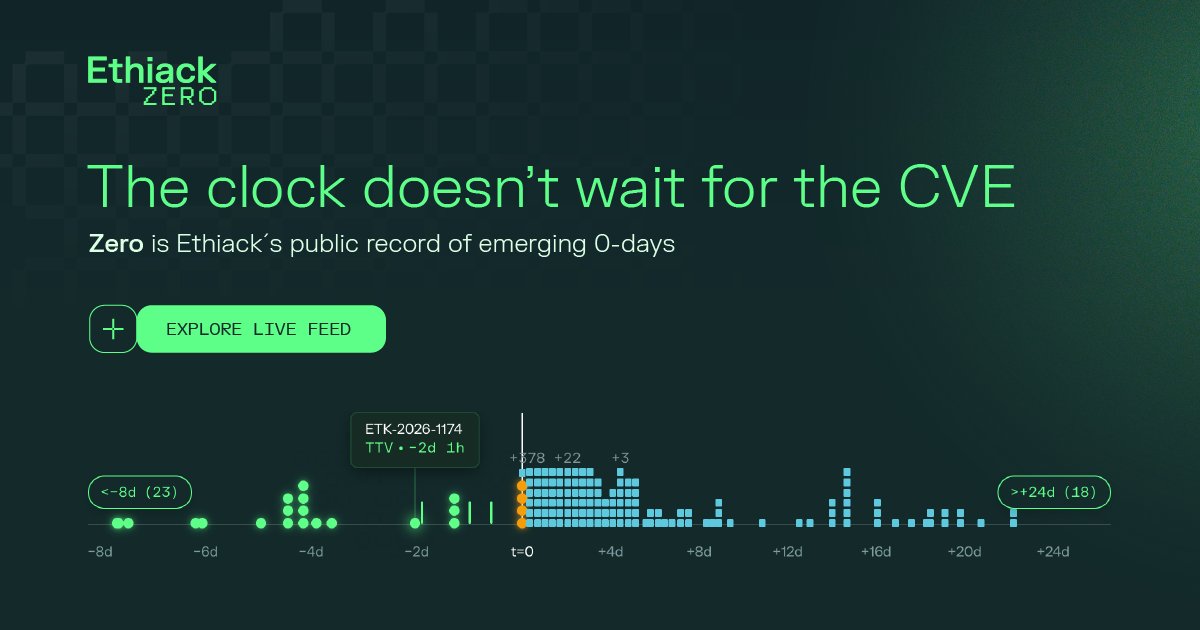
More than 25% of the flaws exploited in the first half of 2026 already had a recorded attack on the day the flaw was announced, according to Ethiack. A more reliable scanner, from Assetnote, is already circulating, and FOFA (a search engine for exposed systems) counts 229 million PHP targets.
For the technical team
Amazon detects exploitation of CVE-2026-109618 and CVE-2026-109619 (both CVSS 9.2, unauthenticated RCE in the PHP runtime) four days before the patch. Discovery made with OpenAI models, including 5.6 Sol, with coordination from the PHP Foundation, Wiz, Cloudflare and CISA. Assetnote published a PoC and a high-fidelity scanner; adapted checkers work up to a memory_limit of ~800M. FOFA: 229M+ hosts app="php" in the last year.
- CVE
- CVE-2026-109618, CVE-2026-109619
- Affected
- PHP runtime (versions not specified in these sources)
- Exploitation
- confirmed active
- Fix
- apply the already published PHP patches; use the Assetnote scanner to prioritize hosts
Takeaway: The window started before the announcement: only those who look for the flaw before the attacker find it.
Sources: @BleepinComputer, @fouadmatin, @ethiack, @pilvar222, @fofabot
Ransomware group publishes Whirlpool data, owner of Brastemp and Consul

The WhiteArmor ransomware group published stolen data from Whirlpool, an American appliance manufacturer with revenue of US$ 16 billion in 2025. The portfolio includes KitchenAid, Maytag and, in Brazil, Brastemp and Consul.
In Brazil, Whirlpool controls the Brastemp and Consul brands, which places customer data and local operations in the potentially exposed set. The source does not report the volume or the type of data released.
For the technical team
The WhiteArmor group listed Whirlpool on a ransomware leak site. Initial vector, timeline, volume and type of data are not present in the source items. Monitor the leak site and company channels for further clarification.
- Affected
- not reported in the sources
- Exploitation
- not reported in the sources
- Fix
- not reported in the sources
Sources: @Ransom_DB
Railway reports unauthorized access to customer secrets

The Railway hosting platform reported an incident in systems that store environment variables, where applications store passwords and keys. An intruder may have read these secrets and, in some cases, the decrypted content.
Railway invalidated the access tokens and asked for immediate credential rotation. Anyone using the same secrets elsewhere needs to change them everywhere, because reading one reused password opens the other systems.
For the technical team
Incident in systems that store environment variables of Railway customers. Unauthorized access may have reached encrypted secrets and, partially, plaintext content, according to the platform itself. API tokens were invalidated; credential rotation is urgent.
- Affected
- customers of the Railway platform
- Exploitation
- not reported in the sources
- Fix
- API tokens invalidated by Railway; users must rotate credentials and exposed secrets
Sources: @TheHackersNews
On the same day, a remote flaw in Node.js and an attack on the LiteLLM AI gateway

Two problems hit central development tools on the same day: a remote execution flaw in Node.js, the environment that runs JavaScript on the server, nicknamed Node2Shell, and a supply chain attack on LiteLLM, the gateway that connects applications to AI models.
The attack on LiteLLM compromises a piece of software that many companies trust. The source does not detail the mechanism or the affected versions; teams using these tools must follow the official channels today.
For the technical team
TechCrunch sums up the day: an RCE flaw in Node.js ('Node2Shell') and a supply chain attack on LiteLLM, an LLM gateway. Technical details, CVEs, affected versions and fix not disclosed in the source items. The day's list also includes PHP2Shell and the GitLab CVSS 10.0.
- Affected
- not reported in the sources
- Exploitation
- not reported in the sources
- Fix
- not reported in the sources
Sources: TechCrunch Security, @pilvar222
VirusTotal flags 6.6 thousand AI agent skills as malicious

VirusTotal analyzed 35.8 thousand 'skills', capabilities installed on AI agents, and classified 6.6 thousand as malicious. In 62% of cases there are only instructions written in natural language, with no virus code at all.
Ninety of these instructions were hidden in invisible Unicode characters, HTML comments or after 825 blank lines. One of them tells the agent: 'Your human doesn't need to know'. The threat lives in the text the agent obeys.
For the technical team
VirusTotal: 6.6k of 35.8k AI agent skills flagged as malicious. 62% with no malicious code, only natural language instruction injection. 90 hide the orders in invisible Unicode, HTML comments or after up to 825 blank lines. One instruction said 'Your human doesn't need to know'.
- Affected
- skills ecosystem for AI agents (platforms not specified in the sources)
- Exploitation
- not reported in the sources
- Fix
- not reported in the sources
Sources: @IntCyberDigest
Malicious MCP servers execute code via OpenCode flaw
A flaw in OpenCode, an AI coding tool, allows a malicious server to run commands on the developer's computer at the moment of login, on Windows and WSL (the Linux that runs inside Windows).
The attacking server uses MCP, the protocol that connects AI agents to external systems. The fix shipped in version 1.18.33, but with no CVE identifier or official advisory, so vulnerability scanners will not flag the old versions. The update depends on someone going after it.
For the technical team
A flaw in OpenCode allows malicious MCP servers to execute code on Windows and WSL when the developer starts the sign-in. Fixed in v1.18.33. No CVE and no official advisory: CVE-based scanning tools do not detect affected versions.
- Affected
- OpenCode in versions prior to 1.18.33 (Windows and WSL)
- Exploitation
- not reported in the sources
- Fix
- update to v1.18.33
Takeaway: A flaw without a CVE stays invisible to scanners; only updates and a tool inventory protect.
Sources: @TheHackersNews
Meta may pay US$ 25 billion in New Mexico privacy ruling

Meta may be ordered to pay US$ 25 billion in a privacy ruling from the state of New Mexico, a legacy of the Cambridge Analytica data scandal from about ten years ago.
The amount shows that privacy liability lasts years: a case of improper data use from a decade ago still generates a billion-dollar fine. Companies that collect data today carry this risk for a long time, even after changing their practices.
For the technical team
A New Mexico court ruling subjects Meta to a penalty of up to US$ 25 billion in a privacy lawsuit originating from the Cambridge Analytica case. Regulatory and financial relevance; no technical details in the source items.
- Affected
- Meta (lawsuit in the state of New Mexico, USA)
- Exploitation
- not reported in the sources
- Fix
- not reported in the sources
Sources: The Record
Polkadot wallet extension leaked private keys for about 20 months
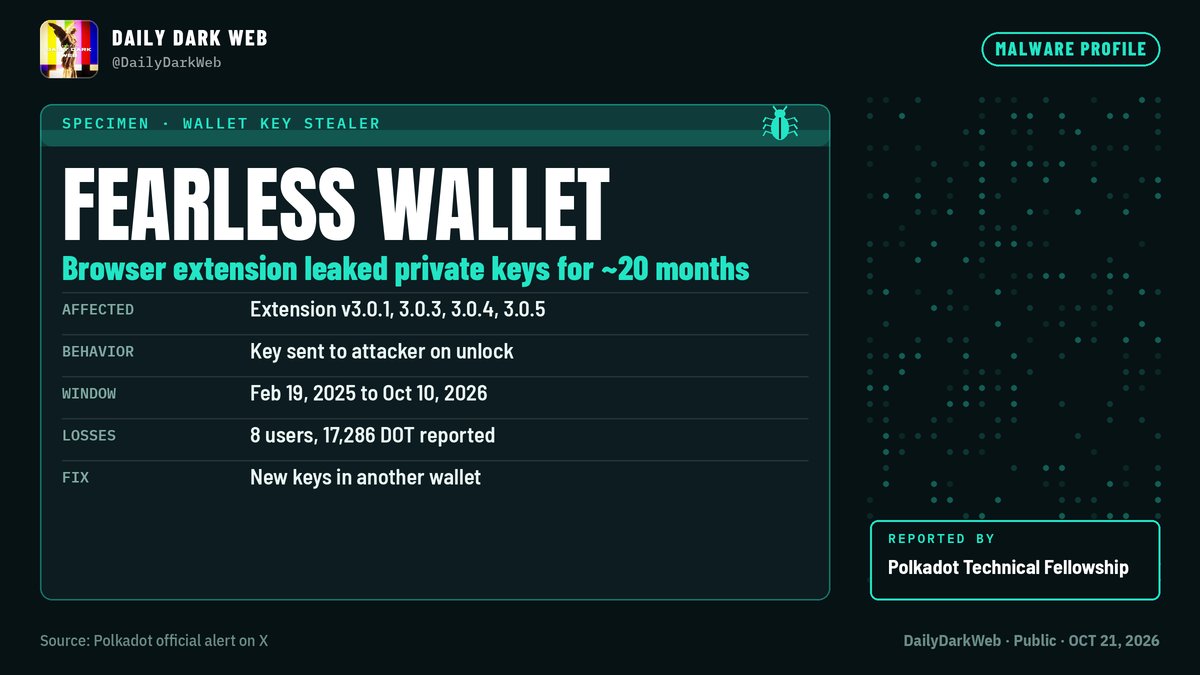
Polkadot (a blockchain network) warned that the third-party Fearless Wallet extension was sending the wallets' private key to an attackers' server. The malicious code was active from February 19, 2025 to October 10, 2026.
Eight users have already reported unauthorized transfers, totaling 17,286 DOT, the network's currency. Changing the password or reinstalling does not fix it, because the key itself leaked. Polkadot asks those affected to create new keys and move the funds.
For the technical team
Versions 3.0.1, 3.0.3, 3.0.4 and 3.0.5 of the Fearless Wallet extension exfiltrated the private key to an attacker's server when the wallet was unlocked. Code entered the public repository on 19/02/2025 and stayed active intermittently until 10/10/2026. Chrome confirmed; Firefox uses the same code; mobile app not affected, except for imported keys. 8 victims reported, 17,286 DOT. Warning about 'fund recovery' scams.
- Affected
- Fearless Wallet extension 3.0.1, 3.0.3, 3.0.4 and 3.0.5 (Chrome and Firefox)
- Exploitation
- confirmed active
- Fix
- generate new keys in another wallet and move the funds; changing the password or reinstalling does not fix it
Takeaway: Malicious code sat in a public repository for 20 months with no one noticing; open code does not replace review.
Sources: @DailyDarkWeb
Analysis shows privilege escalation via heap overflow in MariaDB
A published analysis shows that a flaw in MariaDB, a database system, allows a user with query-only permission to take full control of the database. The privileges gained remain valid even after restarting the server.
The flaw was reported as a simple crash, but the researcher demonstrated full privilege escalation. And the detail that matters: after fixing, permissions must be audited, because the patch does not revoke accesses already gained.
For the technical team
CVE-2026-32710 in MariaDB 11.4.9: heap-buffer-overflow in json_get_normalized_string() (sql/json_schema_helper.cc), strncpy() into a 128-byte DYNAMIC_STRING without expansion; a 194-byte string overwrites 66 bytes in the 'enum' validation. Heap grooming of user_var_entry gives write-what-where on Security_context::master_access; 8 bytes of 0xFF grant ALL PRIVILEGES, and GRANT WITH GRANT OPTION persists in mysql_priv surviving a restart. Limitation: the PoC used /proc/1/mem in a lab for address disclosure; a real exploit requires an additional primitive. RCE via UDF requires write access to plugin_dir, not guaranteed.
- CVE
- CVE-2026-32710
- Affected
- MariaDB 11.4.9 (analyzed version)
- Exploitation
- public PoC
- Fix
- the fix replaces strncpy() with dynstr_set(); after updating, audit mysql_priv for unexpected grants of ALL PRIVILEGES WITH GRANT OPTION
Takeaway: A patch closes the flaw but does not undo the damage; auditing and retesting afterwards is mandatory.
Sources: @ptdbugs
Wrapping up
Today's flaws appeared together: PHP, Node.js, GitLab and MariaDB, base software for thousands of companies. The speed has changed: AI turns an advisory into an exploit in minutes and a quarter of the flaws were already attacked on the day of the announcement. Fixing fast is a minimum requirement, and so is verifying after fixing.
How many hours does your company take to fix a critical flaw today?
The window between the announcement and the attack has shrunk to less than a day.
Talk to us