In 30 seconds
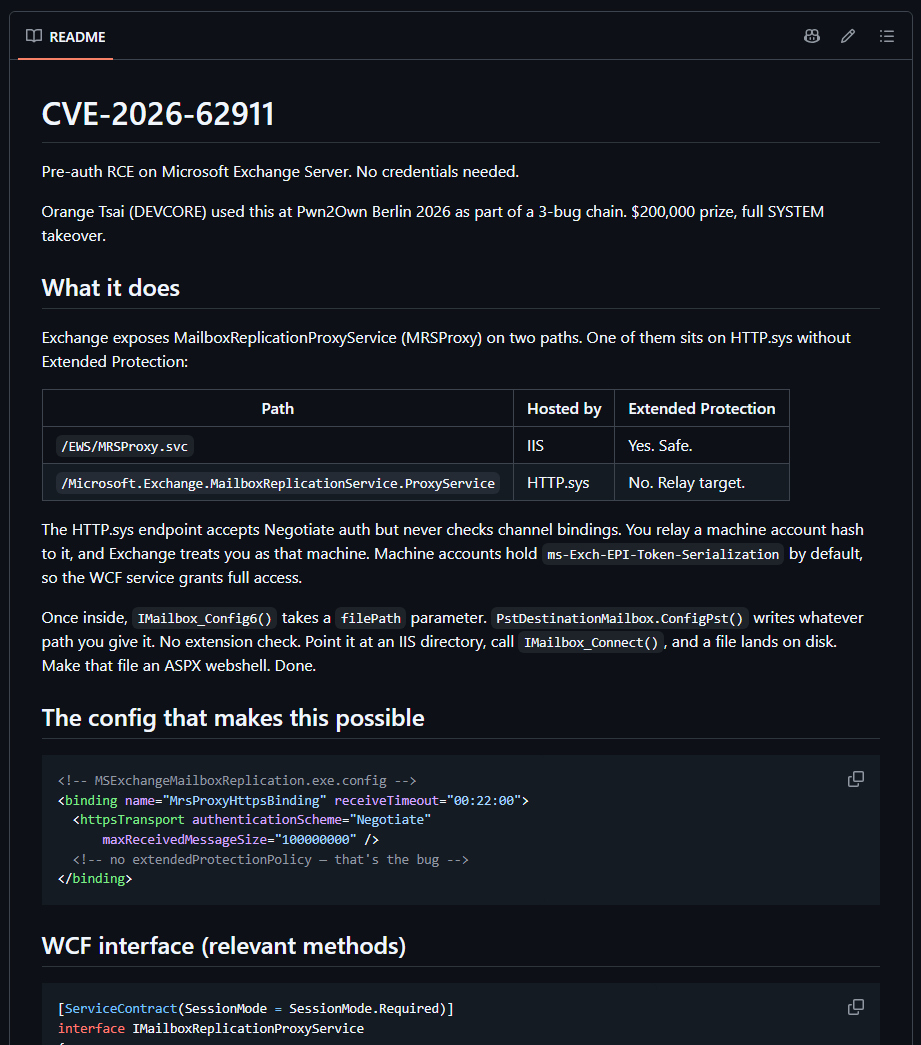
Public exploit code for CVE-2026-62911, an authentication flaw in Microsoft Exchange Server, is now sitting on GitHub for anyone to pull. That alone would be routine. What makes this one worth a fast look is the claim around it: according to the security account DarkWebInformer, the code does not stop at bypassing a login check, it chains a relay attack against Exchange's mailbox move service into writing a webshell, ending with code running as SYSTEM, the highest privilege on a Windows box.github.comgithub.com · rssOpen original sourceSee in source listDarkWebInformerx.com · DarkWebInformer · xOpen original sourceSee in source list
As reported, the flaw is an authentication bypass by capture-replay, meaning an attacker reuses a captured login exchange instead of knowing a password. The public PoC is said to combine that with an NTLM relay aimed at MRSProxy, the mailbox move service, and ultimately drop a webshell on disk: attacker-controlled code reachable through the web server. The report scores it CVSS 8.0, high severity, over the network.DarkWebInformerx.com · DarkWebInformer · xOpen original sourceSee in source list
The fix, per the same report, shipped in Microsoft's August 2026 security updates. Any Exchange 2016 CU23, 2019 CU14 or CU15, or Subscription Edition RTM build below the patched versions is described as exposed, so the practical move is patching, starting with servers that face the internet.DarkWebInformerx.com · DarkWebInformer · xOpen original sourceSee in source list
What happened
The sequence, as the evidence shows it, starts with a GitHub repository under the account hypnguyen1209 publishing proof-of-concept code named after CVE-2026-62911. The repo is the primary artifact here: it exists, it is public, and it is the thing both attackers and defenders will now grab.github.comgithub.com · rssOpen original sourceSee in source list
Alongside the repo, DarkWebInformer posted a breakdown. In that telling, the flaw is an authentication bypass by capture-replay in Exchange Server, and the PoC chains an NTLM relay against the MRSProxy service, writes a webshell to disk, and reaches code execution as SYSTEM.DarkWebInformerx.com · DarkWebInformer · xOpen original sourceSee in source list
The same post maps the blast radius: Exchange Server 2016 CU23, 2019 CU14 and CU15, and Subscription Edition RTM below patched builds, with a network-based attack vector and a path from privilege escalation to SYSTEM-level execution. The fix, it says, arrived in the August 2026 security updates.DarkWebInformerx.com · DarkWebInformer · xOpen original sourceSee in source list
Why it matters
Exchange servers hold an organization's mail, calendars and files, and they run with deep privileges inside Active Directory. If the claimed chain holds, SYSTEM-level code execution there is not just one server lost: it is mailbox access, credential theft from memory, and a natural launching point into the rest of the network.DarkWebInformerx.com · DarkWebInformer · xOpen original sourceSee in source list
There is also an urgency problem baked into this class of event. A working public PoC turns a theoretical patch priority into a concrete one, because the gap between a researcher's demo and opportunistic scanning is usually measured in days, not months.github.comgithub.com · rssOpen original sourceSee in source list
What to do
First action: install the August 2026 Exchange security updates on every server, and put internet-facing ones at the front of the queue. That guidance follows directly from the report's claim that builds below the patched versions remain exposed.DarkWebInformerx.com · DarkWebInformer · xOpen original sourceSee in source list
While patching proceeds, two damage-limiting moves follow from the described chain: keep MRSProxy disabled or restricted on servers that do not need mailbox moves, and hunt for unexpected script files in web directories, which is where a webshell would land. Neither is vendor guidance from this batch, they are reasonable inferences from how the PoC is said to work.DarkWebInformerx.com · DarkWebInformer · xOpen original sourceSee in source list
Confirmed and still uncertain
What the evidence supports so far: a public PoC repository exists, and one well-followed account describes a specific and plausible chain from auth bypass to SYSTEM. Those are, respectively, the fact and the allegation.github.comgithub.com · rssOpen original sourceSee in source listDarkWebInformerx.com · DarkWebInformer · xOpen original sourceSee in source list
What nobody in this batch has shown: a Microsoft advisory confirming the details, a vendor-issued severity score, independent testing of the PoC, or any sign of exploitation in the wild. Until those appear, treat the full bypass-to-SYSTEM chain as a strong but single-source claim.github.comgithub.com · rssOpen original sourceSee in source listDarkWebInformerx.com · DarkWebInformer · xOpen original sourceSee in source list
What people are saying
DarkWebInformer is the only voice in the batch, and its framing is blunt: a high severity, network-based authentication bypass that 'can be chained into SYSTEM-level code execution', with the PoC demonstrating the relay against MRSProxy and showing how the flaw 'can be combined with other primitives to achieve full server compromise'.DarkWebInformerx.com · DarkWebInformer · xOpen original sourceSee in source list
The GitHub author, hypnguyen1209, has said nothing we can see in this batch beyond publishing the code itself. In PoC releases silence from the author is normal, but it also means there is no statement of scope, intent or reliability to lean on.github.comgithub.com · rssOpen original sourceSee in source list
Evolution
Rewinding the timeline: Microsoft shipped the fix in its August 2026 security updates, per the report, roughly three months before the PoC appeared. That gap between patch and public exploit is exactly the window organizations were supposed to use.DarkWebInformerx.com · DarkWebInformer · xOpen original sourceSee in source list
The story then jumps to November 16, 2026, when the GitHub repo and the DarkWebInformer post surfaced together in our evidence batch. The narrative is at its early stage: code published, first coverage out, independent verification still pending.github.comgithub.com · rssOpen original sourceSee in source listDarkWebInformerx.com · DarkWebInformer · xOpen original sourceSee in source list
Reach
1 independent groups, 1 updates, and 4 engagements.
Technical detail
The mechanics, as DarkWebInformer lays them out: the bug is an authentication bypass by capture-replay, where an attacker replays a recorded authentication exchange instead of producing valid credentials. The PoC then performs an NTLM relay, forwarding a victim's authentication to the MRSProxy endpoint, the service that handles mailbox move requests. From there it is said to write a webshell to disk, a persistent and web-reachable foothold running as SYSTEM.DarkWebInformerx.com · DarkWebInformer · xOpen original sourceSee in source list
Severity and scope per the same post: CVSS 8.0 high, attack vector network-based, impact described as privilege escalation and potential SYSTEM-level code execution. Affected builds are Exchange Server 2016 CU23, Exchange Server 2019 CU14 and CU15, and Exchange Server Subscription Edition RTM below the patched versions.DarkWebInformerx.com · DarkWebInformer · xOpen original sourceSee in source list
Sources and evidence
This story rests on two artifacts: the GitHub repository hypnguyen1209/CVE-2026-62911, the primary source and the PoC itself, and a post from DarkWebInformer on X, the discussion source that supplies every technical detail currently in circulation.github.comgithub.com · rssOpen original sourceSee in source listDarkWebInformerx.com · DarkWebInformer · xOpen original sourceSee in source list
That is a thin base for a claim this strong. The repo's own description is empty in our batch, so the entire bypass-to-SYSTEM narrative traces back to one account. Readers should weight it accordingly and wait for Microsoft's advisory or a second independent analysis before treating the chain as confirmed.github.comgithub.com · rssOpen original sourceSee in source listDarkWebInformerx.com · DarkWebInformer · xOpen original sourceSee in source list
Sources
- github.comgithub.com · rss
- DarkWebInformerx.com · DarkWebInformer · x