In 30 seconds
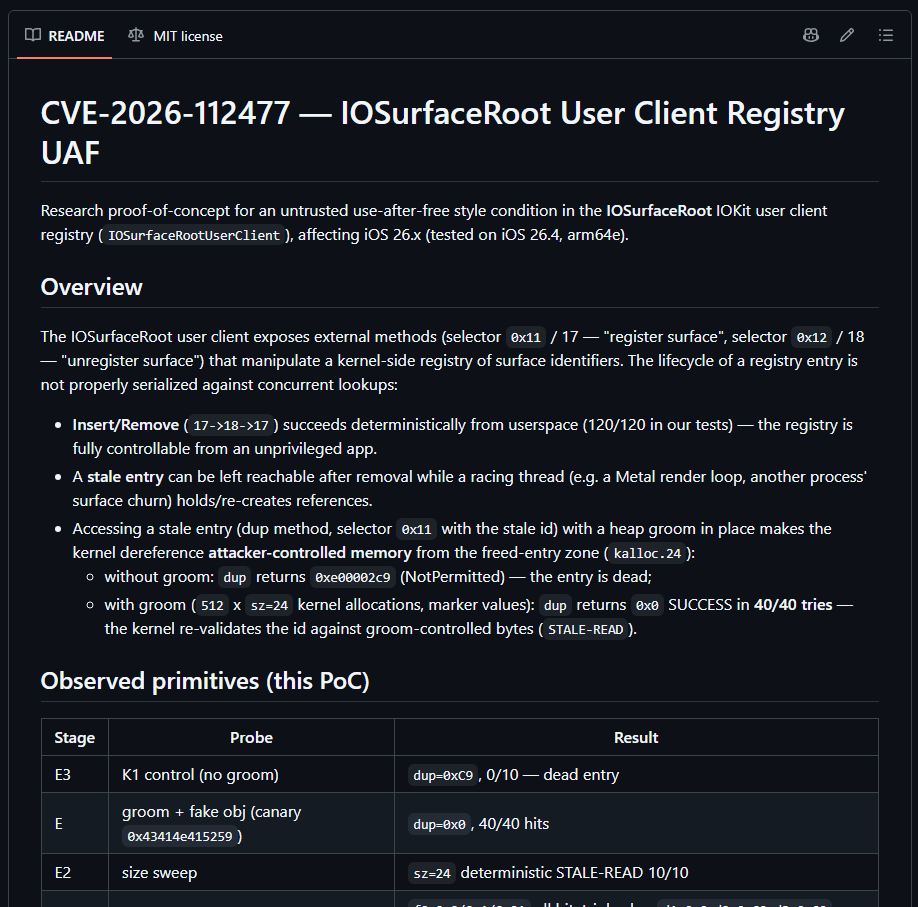
A proof-of-concept for CVE-2026-112477 went public on GitHub today, November 19. The repository, published under the handle Rust505, targets a race condition in Apple's IOSurface subsystem, the kernel layer that manages shared graphics buffers between apps and the GPU. A widely circulated post from security account DarkWebInformer announced the release and laid out the technical claims.github.comgithub.com · rssOpen original sourceSee in source listDarkWebInformerx.com · DarkWebInformer · xOpen original sourceSee in source list
The claimed picture: a local attacker with low privileges can trigger kernel memory corruption or crash the device, a combination rated 7.0 High on the CVSS scale. Unlike earlier summaries suggesting no fix had been mentioned, the write-up lists patched versions across iOS, macOS, tvOS, watchOS and visionOS, though that list comes from a single secondary source.DarkWebInformerx.com · DarkWebInformer · xOpen original sourceSee in source list
What happened
The flaw sits in IOSurfaceRootUserClient, the user-facing doorway into IOSurface. According to the write-up, running register and unregister operations at the same time can leave a stale surface entry reachable after its memory has been freed. That is a use-after-free, meaning the kernel keeps a pointer to memory it has already given back.DarkWebInformerx.com · DarkWebInformer · xOpen original sourceSee in source list
The PoC reportedly adds heap grooming, where an attacker sprays carefully shaped allocations so the freed slot gets refilled with data they control. When the kernel reaches for the stale entry, it touches attacker-chosen bytes instead of the original surface. The demonstration was tested on iOS 26.4 on arm64e, Apple's chip architecture that carries pointer-level protections.DarkWebInformerx.com · DarkWebInformer · xOpen original sourceSee in source list
The GitHub repository and the DarkWebInformer post appeared at the same moment, so public knowledge of this bug starts with a simultaneous release of code and write-up. No prior disclosure thread appears in the evidence.github.comgithub.com · rssOpen original sourceSee in source listDarkWebInformerx.com · DarkWebInformer · xOpen original sourceSee in source list
Why it matters
A reliable use-after-free in the kernel is the raw material of serious exploits. On iPhones, where every app runs sandboxed, a memory corruption primitive reachable from low privileges is exactly the kind of building block attackers chain with other bugs to escape a sandbox or gain root. That is why security watchers flag these releases even when no full exploit exists yet.DarkWebInformerx.com · DarkWebInformer · xOpen original sourceSee in source list
The write-up is explicit about the limits: the repository demonstrates the use-after-free primitive and stale-entry reuse but includes no privilege escalation and no kernel code execution. So the danger today is potential rather than a demonstrated takeover, and the bug carries a 7.0 High rating rather than a critical one.DarkWebInformerx.com · DarkWebInformer · xOpen original sourceSee in source list
What to do
If you use Apple devices, the practical step is to get current. The write-up names iOS and iPadOS 26.7.2 and 27.2, macOS 15.8.2, 26.7.2 and 27.2, plus matching tvOS, watchOS and visionOS builds as fixed. Treat those version numbers as second-hand until Apple's own security page confirms them.DarkWebInformerx.com · DarkWebInformer · xOpen original sourceSee in source list
For defenders, the attack path matters: it is local and needs only low privileges, so it presupposes malicious code already running on the device, for example a hostile app. Worth watching for an official Apple advisory and any sign this primitive shows up in real-world exploit chains.DarkWebInformerx.com · DarkWebInformer · xOpen original sourceSee in source list
Confirmed and still uncertain
Established so far: a public PoC repository exists, one detailed third-party write-up describes the bug mechanics, and that write-up says testing was done on iOS 26.4 on arm64e with no privilege escalation included in the code.github.comgithub.com · rssOpen original sourceSee in source listDarkWebInformerx.com · DarkWebInformer · xOpen original sourceSee in source list
Still open: the repository contents have not been independently reviewed in this evidence batch, only its URL, and every technical detail from CVSS to the fix list traces back to a single secondary account. There is no Apple advisory in the evidence, no confirmation from Apple, and no report of exploitation in the wild.github.comgithub.com · rssOpen original sourceSee in source listDarkWebInformerx.com · DarkWebInformer · xOpen original sourceSee in source list
What people are saying
The public conversation so far is dominated by DarkWebInformer, whose post frames the release as an IOSurface use-after-free causing kernel memory corruption and walks through the CVSS score, the affected versions and the fixes. No researcher rebuttals and no Apple statement appear in the current evidence.DarkWebInformerx.com · DarkWebInformer · xOpen original sourceSee in source list
Evolution
The story has already shifted once. The earlier working summary held that no fix had been mentioned, while the new write-up explicitly lists patched versions across five operating systems. Evidence beats continuity, so the fix claim now defines the current picture, pending Apple's own advisory.DarkWebInformerx.com · DarkWebInformer · xOpen original sourceSee in source list
The release itself also moved things forward: it reportedly turns a timing bug into a demonstrated primitive, with code showing the stale entry can be recycled with attacker-controlled data, a concrete step beyond a bare bug report.github.comgithub.com · rssOpen original sourceSee in source listDarkWebInformerx.com · DarkWebInformer · xOpen original sourceSee in source list
Reach
1 independent groups, 1 updates, and 5 engagements.
Technical detail
Mechanically, the bug is a race between concurrent register and unregister calls on IOSurfaceRootUserClient. The unregister frees the surface entry, but another thread can still reach it through the stale reference. Heap grooming then aims reallocation of that slot at attacker-controlled data, turning a narrow timing window into a kernel memory corruption primitive.DarkWebInformerx.com · DarkWebInformer · xOpen original sourceSee in source list
Two boundaries stand out. The test bed was iOS 26.4 on arm64e, which carries pointer authentication and other hardening, so the primitive works despite those mitigations, according to the write-up. And the repository stops at corruption: no privilege escalation, no kernel code execution, no sandbox escape.DarkWebInformerx.com · DarkWebInformer · xOpen original sourceSee in source list
Sources and evidence
This report rests on two items: the GitHub repository for CVE-2026-112477 under the Rust505 handle, which serves as the primary artifact, and a single post from DarkWebInformer on X, which supplies every technical and version detail cited here. The repository contents were not directly readable in this evidence batch, so the write-up carries the descriptive weight and its claims should be checked against Apple's advisory when one lands.github.comgithub.com · rssOpen original sourceSee in source listDarkWebInformerx.com · DarkWebInformer · xOpen original sourceSee in source list
Sources
- github.comgithub.com · rss
- DarkWebInformerx.com · DarkWebInformer · x