
In 30 seconds
The latest supplied report alleges that CVE-2026-121481 is an OpenSSL Base64 buffer overflow rated 9.8, but says exploitation requires roughly 1.6 GB of input and that no practical remote-code-execution attack has been demonstrated.TheHackersNewsx.com · TheHackersNews · xOpen original sourceSee in source list
What happened
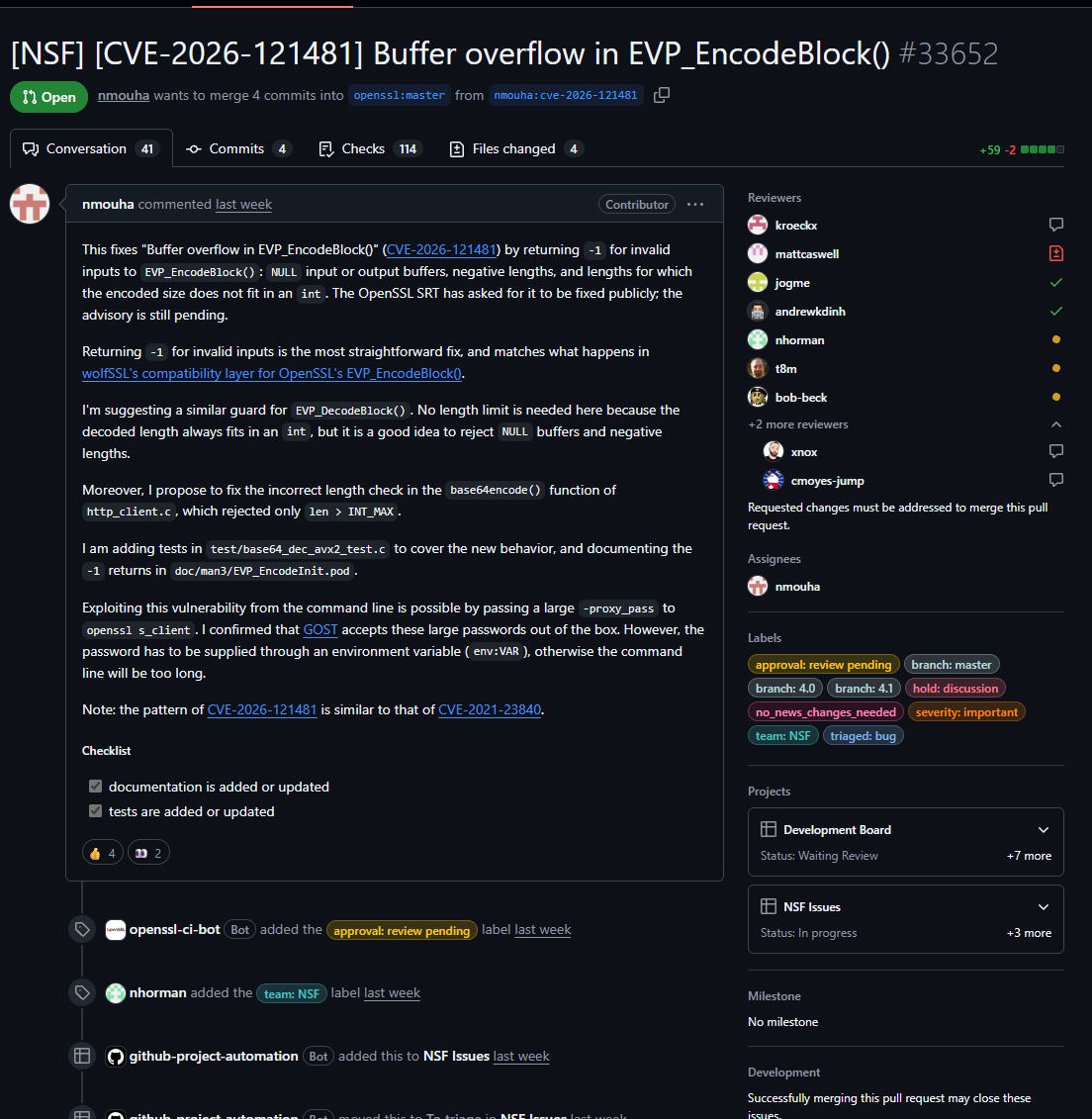
An X post from TheHackersNews described the alleged overflow and linked it to a GitHub pull request in the openssl/openssl repository. The supplied GitHub item contains no title or body, so this evidence does not independently establish the technical claims.TheHackersNewsx.com · TheHackersNews · xOpen original sourceSee in source listgithub.comgithub.com · rssOpen original sourceSee in source list
Why it matters
If the reported input requirement is accurate, the unusually large payload could make exploitation harder in real deployments despite the alleged 9.8 severity score. That is an assessment of practicality, not proof that the flaw is harmless or unreachable.TheHackersNewsx.com · TheHackersNews · xOpen original sourceSee in source list
What to do
The supplied evidence provides no affected-version list, patch status, advisory, workaround or upgrade instruction. It therefore does not support a specific remediation step beyond checking authoritative OpenSSL guidance before making operational decisions.github.comgithub.com · rssOpen original sourceSee in source listTheHackersNewsx.com · TheHackersNews · xOpen original sourceSee in source list
Confirmed and still uncertain
The batch shows a public claim about the CVE identifier, severity, overflow type, approximate input size and absence of demonstrated practical remote RCE. It does not establish which versions or applications are affected, whether a fix exists, how the 1.6 GB threshold was measured, or whether other exploitation paths are possible.TheHackersNewsx.com · TheHackersNews · xOpen original sourceSee in source listgithub.comgithub.com · rssOpen original sourceSee in source list
What people are saying
TheHackersNews argues that the case illustrates why a high CVSS score does not necessarily translate into high real-world exploitability, pointing to the alleged payload size and lack of demonstrated practical remote RCE.TheHackersNewsx.com · TheHackersNews · xOpen original sourceSee in source list
Evolution
Both supplied items carry the same publication timestamp. One points to GitHub pull request 33652, while the other adds the substantive security claims on X, leaving the earlier discovery, disclosure and remediation timeline absent from this batch.github.comgithub.com · rssOpen original sourceSee in source listTheHackersNewsx.com · TheHackersNews · xOpen original sourceSee in source list
Reach
1 independent groups, 1 updates, and 2 engagements.
Technical detail
The only technical description says the issue is a buffer overflow during Base64 processing and requires an input of about 1.6 GB. The evidence supplies no triggering code path, memory-layout analysis, proof of concept or explanation of whether the result is a crash, memory corruption or controllable code execution.TheHackersNewsx.com · TheHackersNews · xOpen original sourceSee in source list
Sources and evidence
The evidence base is thin: the GitHub record supplies a pull-request URL but no captured content, while the X post contains all material claims about severity and exploitability. Those claims remain uncorroborated within the supplied batch.github.comgithub.com · rssOpen original sourceSee in source listTheHackersNewsx.com · TheHackersNews · xOpen original sourceSee in source list
Sources
- TheHackersNewsx.com · TheHackersNews · x
- github.comgithub.com · rss