Tailscale confirms flaws; Laravel fixes critical bypass
Confirmed unpatched flaw in Tailscale, critical bypass in Laravel, and secrets stolen at scale on GitHub.
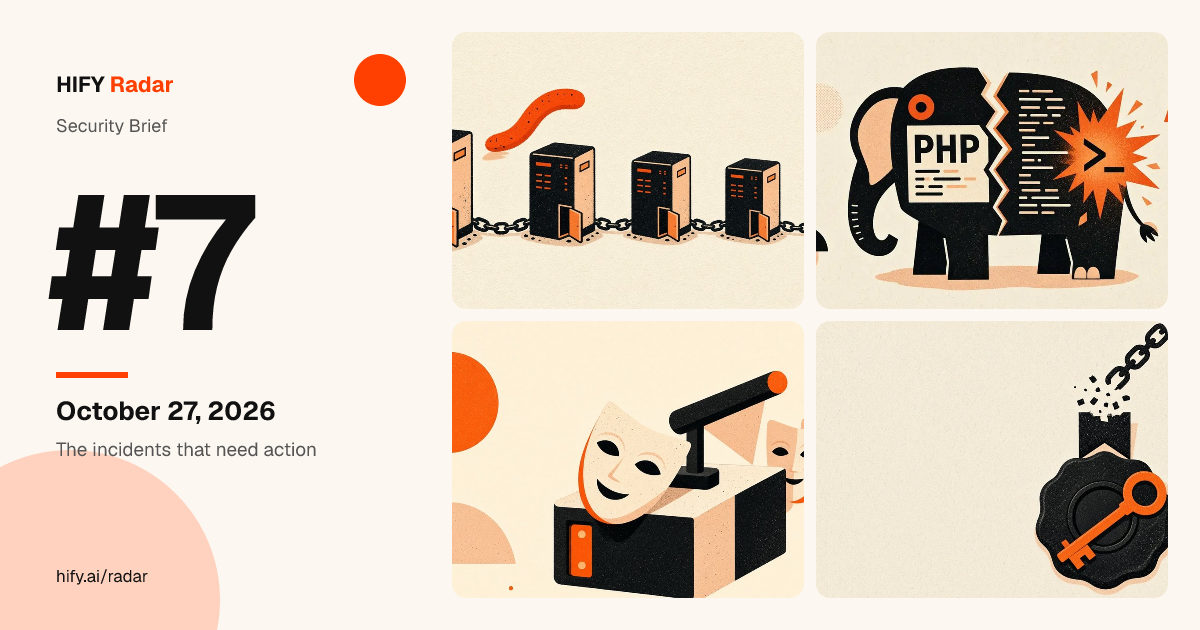
The 30-second summary
- Tailscale confirmed the 11 flaws reported without coordinated disclosure; fix promised within 24 hours, still no CVE or patched version.
- PHP2Shell remains without a fix in versions 8.1 and earlier; vendors such as QNAP, Oracle and IBM publish patches for products that embed PHP.
- Laravel fixed a critical API authentication bypass: without a token, an attacker could sign in as any user. Update to 12.68.0 or 13.29.0.
- The cause of the attack on LiteLLM came to light: an administration key leaked in May and never revoked allowed the hijacking of the release pipeline.
- The Gheist group injected malicious workflows into 13,500 GitHub branches; secrets appeared in logs that the attackers deleted seconds later.
Tailscale confirms real flaws and promises a fix within 24 hours
Tailscale confirmed that the 11 flaws pointed out by the Tailworm audit, published without prior notice on October 25, are real. The company classified the problems as serious, mostly privilege escalation, and said it expects to fix them within 24 hours.
The attack assumes a device already compromised: from it, the attacker obtained administrator access on other servers via Tailscale SSH, according to lab tests. There was no numbered patched version as of October 27; teams must apply the mitigations until the fix comes out.
For the technical team
Eleven flaws in the Tailscale client (tailscaled, Tailscale SSH, serve, app connectors) and in headscale, disclosed without coordination by researcher Erica Windisch of Cyberdione Labs. Race conditions in the SSH server embedded in tailscaled, which runs as root, allow privilege escalation and lateral movement via port forwarding.
- Affected
- tailscale v1.104.2 and headscale v0.29.5 (versions tested in the Tailworm report)
- Exploitation
- not observed
- Fix
- No numbered version as of 10/27/2026; Tailscale targets a fix within 24 hours. Mitigations: TS_SSH_DISABLE_FORWARDING=1 on the tailscaled service and a restart, restricted SSH rules, removal of unused app connector capabilities, and memory limits on exposed headscale
Takeaway: Trust in a private network does not replace regular testing: one compromised host reached servers across the fleet.
Sources: Tailscale, @TheHackersNews, @IntCyberDigest, @The_Cyber_News
On the radarFollow this incident live →PHP2Shell: wave of fixes reaches products that embed PHP
The JPCERT/CC advisory (Japan's incident response center), updated on October 26, lists fixes for products that embed PHP: QNAP, Oracle, Check Point, IBM SevOne, PAN-OS on Siemens RUGGEDCOM, and Peplink. The PHP2Shell flaws already have confirmed exploitation on the internet.
Old versions remain exposed: PHP fixed the flaws in versions 8.5.12, 8.4.27, 8.3.36 and 8.2.35, but unsupported ones, 8.1 and earlier, require migration. According to Unit 42, at one European government attackers tried to become domain administrators in about two hours.
For the technical team
CVE-2026-109618 (OOM bailout to UAF) and CVE-2026-109619 (state corruption to UAF): unauthenticated RCE, CVSS 9.2. Unit 42 confirms post-exploitation conducted with AI agents, marked by commands with delimiters such as ==SHELLUSER== and ==PASSWD==, access to password hashes and MFA secrets, and an NTLM-relay tunnel to Active Directory.
- CVE
- CVE-2026-109618, CVE-2026-109619
- Affected
- PHP 5.4 to 8.5.11 on all branches serving web requests; EOL versions 8.1 and earlier without a fix from the PHP project; QNAP, Oracle, IBM SevOne products, PAN-OS on Siemens RUGGEDCOM APE1808, and Peplink
- Exploitation
- confirmed active
- Fix
- PHP 8.5.12, 8.4.27, 8.3.36 and 8.2.35; Ubuntu, RHEL (RHSA-2026:87151), Peplink, IBM and other vendor packages; migrate EOL versions to a supported branch
Sources: JPCERT/CC, @DailyDarkWeb, @zerodayalpha
On the radarFollow this incident live →Laravel fixes authentication bypass in TokenGuard
Laravel fixed a critical flaw in TokenGuard, the default token-based API authentication mechanism. In certain MySQL and MariaDB database configurations, an attacker without credentials could sign in as any existing user, without knowing that user's token.
The effect is account takeover: it applies to any route protected by this guard, with a CVSS score of 9.2. The fix was released on October 23 in versions 12.68.0 and 13.29.0; applications with token-based APIs on MySQL or MariaDB must update and review logs.
For the technical team
CVE-2026-114509: authentication bypass in TokenGuard with non-string API credentials. Depending on MySQL/MariaDB comparison behavior, the query accepts an invalid credential and authenticates as an arbitrary existing user. There is a public PoC and more than 2.8 million exposed Laravel surfaces mapped on the internet in the last year, according to @fofabot.
- CVE
- CVE-2026-114509
- Affected
- laravel/framework < 12.68.0; >= 13.0.0, < 13.29.0
- Exploitation
- public PoC
- Fix
- Update laravel/framework to 12.68.0 (line 12) or 13.29.0 (line 13) and review API authentication logs
Takeaway: An authentication flaw stays in production for years until someone tests the login with non-standard inputs.
Sources: laravel/framework, @fofabot, NVD
On the radarFollow this incident live →403 Indian government sites still have revoked eMudhra certificates
Tensorust found 403 sites of the Indian government still displaying revoked eMudhra certificates (India's digital certificate authority), after the compromise of authorities that issue digital certificates. eMudhra apologized and announced a review by specialists.
With the private keys recoverable, anyone holding them can issue certificates that unupdated systems accept as genuine and intercept HTTPS connections. Go, Node.js, Python, Electron, NSS and Java have released versions that remove the trust; no exploitation has been reported.
For the technical team
Private keys of eight eMudhra (emSign) TLS intermediates were demonstrated as recoverable from the public certificates on 10/17/2026, and the certificates were revoked on 10/18. Java does not check revocation by default, so Java applications and Docker images with embedded Java require their own fixes (Web3Signer up to 26.10.1, Teku up to 26.10.2).
- CVE
- CVE-2026-111943, CVE-2026-91403, CVE-2026-115557, CVE-2026-114820
- Affected
- Clients that trust eMudhra ECC intermediates before the blocks of October 17 to 21, 2026; Go before 1.27.3/1.26.10; Electron before 44.9.1/43.8.1/42.11.16; certifi before 2026.10.19; pip before 26.2.2; uv before 0.13.4
- Exploitation
- not observed
- Fix
- Go 1.27.3/1.26.10; Node.js 22.23.4/24.22.1/26.12.1; Electron 44.9.1/43.8.1/42.11.16; Python 3.15.2/3.14.10/3.13.18/3.12.16/3.11.18; certifi 2026.10.19; NSS 3.131.1; listed OpenJDK versions; rebuild Docker images with their own Java and update system ca-certificates
Key leaked in May and never revoked caused the attack on LiteLLM
LiteLLM identified the cause: an administration key, accidentally exposed in May and never revoked, allowed the hijacking of the release pipeline that distributed the malicious version 1.107.0. The Record estimates tens of thousands of affected users.
The malicious version stayed online for three hours with more than 49,000 downloads from the PyPI repository, and it stole browser passwords, cloud keys and AI keys. Wiz reported stolen credentials in use about 4.5 hours later.
For the technical team
litellm==1.107.0 on PyPI and in the Docker/GHCR images (tags v1.107.0, latest, main-latest, main-stable) installed an info-stealer that exfiltrated browser passwords, AWS/GCP/Azure keys, SSH and GPG keys, environment variables and AI API keys to litellm[.]dev. The pipeline was hijacked with stolen GitHub tokens after the master key leak.
- Affected
- litellm==1.107.0; Docker/GHCR images tags v1.107.0, latest, main-latest and main-stable in the window of 10/21/2026
- Exploitation
- confirmed active
- Fix
- Pin to 1.106.2 (last known safe version); 1.107.0 removed from PyPI, Docker Hub and GHCR; rotate every credential reachable from the affected machine, including GitHub tokens, and block litellm.dev
Takeaway: A leaked and forgotten credential became an attack months later; automatic rotation of exposed keys costs less than response.
Sources: The Record, OSV, The Hacker News
On the radarFollow this incident live →Brotli flaw gets remote execution demonstrated and becomes HTTP2Shell
Researchers demonstrated remote code execution exploiting the Brotli compression decoder flaw in a Node.js build, with forged compressed data. The scenario earned the nickname HTTP2Shell and the list of affected software keeps growing.
Any application that decompresses Brotli data from untrusted sources, common in HTTPS responses, can have memory corrupted, data read, or code executed by an unauthenticated attacker. GitHub rates the flaw as critical, CVSS 9.2.
For the technical team
Out-of-bounds write in Google's Brotli decoder, CVE-2026-111497, nicknamed Node2Shell/HTTP2Shell/Broccoli2Shell. An unauthenticated attacker who supplies malicious Brotli data can crash the process, leak memory or execute code. RCE was demonstrated in a Node.js build; the flaw was reported to Node.js by OpenAI's Codex Security. EOL Node.js versions receive no fix.
- CVE
- CVE-2026-111497, CVE-2026-105482, CVE-2026-105483, CVE-2026-106069, CVE-2026-105481, CVE-2026-106072, CVE-2026-106074, CVE-2026-106070, CVE-2026-106071, CVE-2026-106073
- Affected
- Brotli 1.0.3 to 1.0.9, 1.1.0 and 1.2.0; Node.js 22.x before 22.23.4, 24.x before 24.22.1, 26.x before 26.12.1, EOL lines 20.x/23.x/25.x without a fix; Bun before 1.4.4; Envoy and Istio with the Brotli decompressor configured; .NET, Visual Studio and PowerShell before the updates of 10/25/2026
- Exploitation
- public PoC
- Fix
- Node.js 22.23.4/24.22.1/26.12.1; Bun 1.4.4; Brotli 1.2.1/1.1.1/1.0.10; PyPI Brotli 1.2.1 and brotlicffi 1.2.1.0; Envoy 1.40.0/1.39.3/1.38.6/1.37.8; Istio 1.29.9/1.30.6/1.31.2; Microsoft updates of 10/25; restart services and rebuild container images
Sources: Microsoft, The Hacker News, @HacktronAI, @BleepinComputer, @IntCyberDigest
On the radarFollow this incident live →PwnEscape: full analysis of the VM escape and fix in backports
pwn.ai published the full analysis of PwnEscape, a flaw in the part of the Linux kernel that handles networking for virtual machines. Discovered by Paulos Yibelo in Vercel's US$ 1 million challenge, it allows a virtual machine to escape isolation.
With forged packets, a virtual machine reads host server memory, crashes the machine's environments or obtains full privileges. Vercel states that no report from the challenge showed access to customer data. The fix is already in the stable kernel backports.
For the technical team
CVE-2026-99999: flaw on the host side of the Linux kernel network stack. KVM/Firecracker guests send specially forged packets to leak host memory, cause denial of service or execute code with root privileges. Validated in Vercel's sandbox challenge, with a technical write-up and PoC published.
- CVE
- CVE-2026-99999
- Affected
- Kernels earlier than stable backports 5.10.272, 5.15.223, 6.1.190, 6.6.159, 6.12.113, 6.18.57 and 7.2.11 (check vendor packages)
- Exploitation
- public PoC
- Fix
- Upstream commit 6785011f8b16 and corresponding stable backports; update the kernel on virtualization hosts according to distributor packages
Gheist steals secrets from 13,500 GitHub branches with compromised tokens
The Gheist group used stolen tokens to create malicious workflows in more than 13,500 GitHub branches and repositories, according to research by Wiz published on October 25. More than 850 compromised accounts were used, from personal projects to private repositories.
Each workflow printed the repository's secrets in its own log, which the attackers downloaded and deleted seconds later. GitHub's mandatory approval applies only to public repositories, Wiz says; in private ones the workflows ran to completion.
For the technical team
Malicious workflows created via GitHub Actions with access tokens stolen from more than 850 accounts. The workflows displayed repository secrets in the execution logs, downloaded via the API and deleted within seconds. Wiz observed cloud credentials used hours later to enumerate AWS Secrets Manager; logs indicate more than 900 confirmed compromises, with scanning capable of reaching millions of targets.
- Affected
- More than 13,500 branches and repositories; accounts of personal projects, private repositories and GitHub Enterprise Server
- Exploitation
- confirmed active
- Fix
- Revoke exposed tokens, review unknown branches and workflows, replace all secrets accessible to the compromised accounts and check AWS Secrets Manager access logs
Takeaway: A secret printed in a CI log is a secret delivered; reviewing workflows and rotating tokens must be routine.
Sources: Infosecurity Magazine, @TheDFIRReport
On the radarFollow this incident live →Wrapping up
The pattern of the day is the time between flaw and fix: unsupported PHP versions, revoked certificates still active on government sites, and a key leaked in May that became an attack in October. Those who test little discover the problem together with the attacker. Finding, fixing and retesting shortens that interval.
How long does a known flaw take to be fixed here?
In most cases in this issue, the window stayed open for weeks or months.
Talk to us