Old PHP left without a fix; Nextcloud flaw is exploited
Old PHP versions are left without a fix, Nextcloud suffers backdoors and 1.4 million prepaid cards leak in Japan.
The 30-second summary
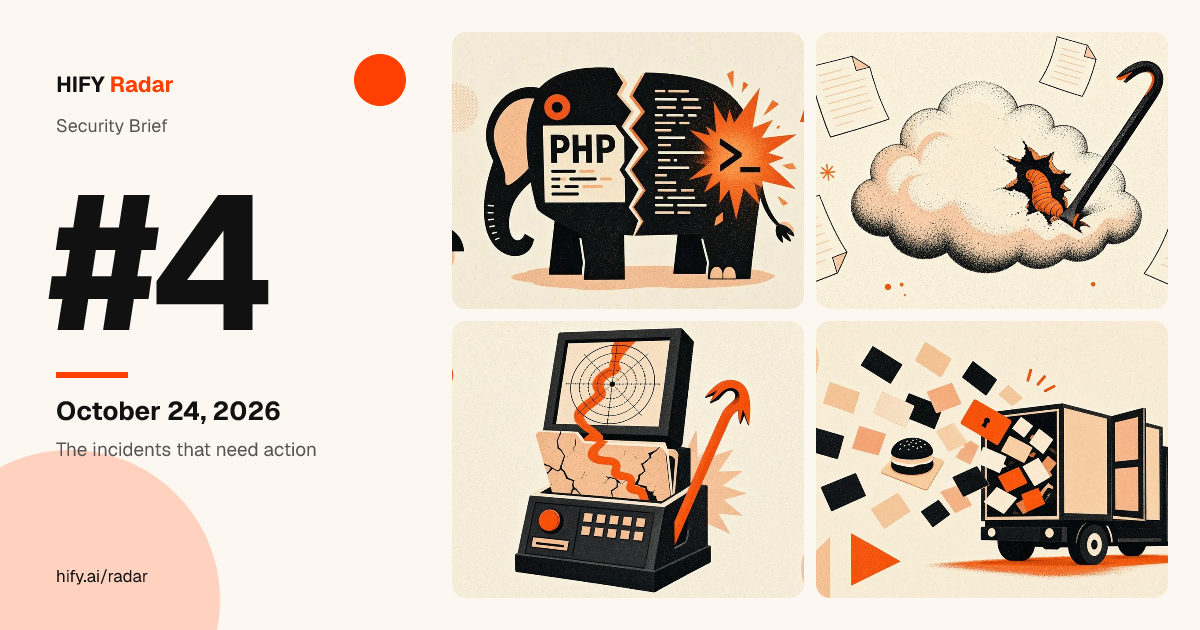
- Old PHP versions are left without a fix for the PHP2Shell flaws, despite official patches in branches 8.2 to 8.5.
- Hackers install backdoors on Nextcloud servers through the Collabora CODE flaw, listed by CISA (the US cybersecurity agency) as actively exploited.
- Canada confirms attacks on FortiSIEM, Fortinet's monitoring tool: command execution without a password, with demonstration code published.
- Japanese vendor exposes 1.4 million prepaid cards with PIN and balance; the MOS Burger chain confirms another 1.1 million records.
- Microsoft releases an emergency .NET fix for the Brotli flaw, which affects Node.js, Bun, proxies and Python packages.
Japanese advisory organizes PHP2Shell fixes; old versions left without a patch

Japan's security center detailed the fixes for the two PHP2Shell flaws: PHP versions 8.5.12, 8.4.27, 8.3.36 and 8.2.35, plus updates from Ubuntu, Red Hat and Peplink. Installations on unsupported versions, 8.1 and earlier, are left without an official fix.
The fix does not even reach everyone. Servers on unsupported versions remain exposed to remote takeover, with no patch planned, and researchers have already documented real PHP2Shell exploitation in production.
For the technical team
CVE-2026-109618 (OOM bailout to use-after-free) and CVE-2026-109619 (state corruption to UAF), unauthenticated RCE on installations serving web requests. zerodayalpha validated the bugs independently and notes the fixes are systemic, closing extra paths without their own CVE. 0x4D31 published what it describes as the first RCE validated in the wild.
- CVE
- CVE-2026-109618, CVE-2026-109619
- Affected
- PHP 5.4 to 8.5.11, all branches serving web requests; 8.1 and earlier without a fix from the PHP project
- Exploitation
- confirmed active
- Fix
- PHP 8.5.12, 8.4.27, 8.3.36 and 8.2.35; Ubuntu, RHEL and Peplink builds
Takeaway: Unsupported software turns each new flaw into a permanent risk, with no patch to wait for.
Sources: JPCERT/CC, TechCrunch Security, @zerodayalpha 1, @zerodayalpha 2, @DailyDarkWeb, @0x4D31
On the radarFollow this incident live →PHP2Shell exploitation goes through a Google proxy; Unit 42 corrects its report
A researcher demonstrated that the PHP flaw works behind Google's reverse proxy, used in services such as Cloud Run. The layer many considered protection did not stop the exploitation, which was carried out with an AI agent.
Palo Alto Networks corrected an earlier assessment. The Unit 42 team withdrew the reading that the attack on a European government involved PHP2Shell: it occurred in the context of a vulnerable PHP application. Rushed attributions confuse the response.
For the technical team
LiveOverflow demonstrated PHP2Shell exploitation behind Google Frontend, the reverse proxy in front of Cloud Run, invalidating the premise that edge proxies block the vector. hakluke reports confirmed RCE exploitation. In parallel, Unit 42 retracted the link between the European government case and the flaw.
- Affected
- not stated in the sources
- Exploitation
- confirmed active
- Fix
- not stated in the sources
Sources: @hakluke, @LiveOverflow, The Hacker News
On the radarFollow this incident live →Nextcloud Collabora flaw is exploited to install backdoors
Hackers break into Nextcloud servers through a flaw in the document editing app, the built-in Collabora CODE. Attackers use the flaw to install backdoors, and CISA (the US cybersecurity agency) added the case to the list of actively exploited flaws.
The fix has existed since September. Servers that have not updated the app may be compromised, with a backdoor installed and corporate data accessible. The alternative is to uninstall the app.
For the technical team
RCE in richdocumentscode (Collabora Online Built-in CODE Server) for Nextcloud, CVSS 9.2. Exploitation in the wild reported with installation of backdoors on exposed servers. Added to CISA's KEV on Friday.
- CVE
- CVE-2026-110447
- Affected
- richdocumentscode before 26.4.303
- Exploitation
- confirmed active
- Fix
- richdocumentscode 26.4.303 or later (latest 26.4.502), or uninstall the app
Takeaway: An optional app, with no clear owner and no updates, is usually the easiest target.
Sources: NVD, The Hacker News, Collabora, GitHub Advisory Database, GitHub, Nextcloud community forum
On the radarFollow this incident live →Canada confirms active exploitation of critical FortiSIEM flaw
Canada confirms real attacks on FortiSIEM installations, Fortinet's monitoring tool. The flaw allows executing commands on the server without a password. Demonstration code was published on October 20.
The security tool became the target. Anyone running outdated FortiSIEM may have the alerting system compromised, giving the intruder visibility of the environment. Fortinet still lists the flaw as having no known exploitation.
For the technical team
CVE-2026-106173 affects the FortiSIEM gRPC QueryResultReq handler: incorrect validation of attacker-controlled metadata allows path traversal and arbitrary file writes, chainable to unauthenticated RCE by overwriting files later executed by the system. CVSS 9.4. Horizon3's PoC published on Oct 20 demonstrates blind execution via the gRPC service on TCP/27918.
- CVE
- CVE-2026-106173
- Affected
- FortiSIEM 7.0.0 to 7.5.0, across multiple release branches
- Exploitation
- confirmed active by Canada's Cyber Centre; Fortinet says it is not aware of exploitation
- Fix
- FortiSIEM 7.5.1 or 7.6.0 and later
Takeaway: An outdated monitoring tool hands the intruder full visibility of the environment.
Sources: @DarkWebInformer, @IntCyberDigest
On the radarFollow this incident live →Japanese vendor exposes 1.4 million prepaid cards with PIN
A payments vendor in Japan confirmed a leak of 1,424,748 records of store prepaid cards, with card identifier, PIN and balance. The MOS Burger snack chain confirmed another 1,133,070 records exposed through the same vendor.
The vendor blocked the access, but the damage reaches third-party customers. The flaw was in the web server of the subsidiary Value Design. Names, addresses and credit card data were left out; no losses were reported as of October 23.
For the technical team
Exploitation of a web server vulnerability at Paycloud's subsidiary Value Design exposed Value Card records (card ID, PIN and balance) and MOS Card records. Access path blocked and forced replacement of the affected PINs. No CVE or ransomware attribution established.
- Affected
- 1,424,748 Value Card records (569,224 with issued IDs); 1,133,070 MOS Card records, about 570 thousand in circulation
- Exploitation
- confirmed active
- Fix
- access blocked by Paycloud; no CVE published
Takeaway: The vendor's flaw leaks your customers' data; the reputation damage is yours.
Sources: @DailyDarkWeb
On the radarFollow this incident live →Microsoft releases emergency .NET fix for the Brotli flaw
Microsoft published an emergency fix in .NET for the flaw in the Brotli decompressor, which affects Node.js, Bun, proxies and Python packages. The company admitted that two fixes from October 13 were insufficient.
The reach goes far beyond Node.js. Decompressing malicious data corrupts the memory of .NET applications, Visual Studio and PowerShell, Envoy and Istio proxies, and Python packages. Every piece of software that receives compressed data from third parties needs an update.
For the technical team
CVE-2026-111497: out-of-bounds write in Google's Brotli decoder. Malformed compressed data corrupts memory, with potential for crash, disclosure and RCE; variants were nicknamed Node2Shell and HTTP2Shell. Reported to Node.js by OpenAI's Codex Security. WAF rules were published as an additional mitigation, without replacing the patch.
- CVE
- CVE-2026-111497, CVE-2026-105482, CVE-2026-105483, CVE-2026-106069, CVE-2026-105481, CVE-2026-106072, CVE-2026-106074, CVE-2026-106070, CVE-2026-106071, CVE-2026-106073
- Affected
- Node.js 22.x before 22.23.4, 24.x before 24.22.1 and 26.x before 26.12.1 (20.x, 23.x and 25.x EOL without a fix); Bun before 1.4.4; Brotli 1.0.3 to 1.2.0; brotli and brotlcficffi from PyPI; Envoy and Istio with the Brotli decompressor; .NET, Visual Studio and PowerShell before the Oct 25 updates
- Exploitation
- not observed
- Fix
- Node.js 22.23.4, 24.22.1 and 26.12.1; Bun 1.4.4; Brotli 1.2.1, 1.1.1 and 1.0.10; Microsoft's October updates
Sources: Microsoft, The Hacker News, @ethiack, @IntCyberDigest, @BleepinComputer, @DarkWebInformer
On the radarFollow this incident live →Tailscale has 11 flaws without a fix; a compromised device moves through the network
An independent audit listed eleven flaws in Tailscale, a private networking tool between servers. The most severe: a single compromised device can obtain administrator access on other servers in the same network. The fix has not been released yet.
The risk starts from a compromised device already authorized on the network. Those who use Tailscale only with their own devices have lower exposure, according to analysts. Tailscale says a fix is in preparation.
For the technical team
Report by Erica Windisch, published without coordinated disclosure, with 11 findings in five groups: Tailscale SSH, serve, app connectors, DERP client and headscale. The SSH server runs inside tailscaled, with root on the machine; race conditions allow escalation and lateral movement via port forwarding between authorized devices, plus addition of a rogue node.
- Affected
- tailscale v1.104.2 and headscale v0.29.5 (versions tested on October 22 to 24)
- Exploitation
- not observed
- Fix
- no patch published; fix announced by Tailscale
Sources: Tailscale, @IntCyberDigest, @The_Cyber_News, @cocktailpeanut, @TheHackersNews, Cyberdione Labs
On the radarFollow this incident live →Closed Solana contract is reverse engineered and reveals a critical flaw
A researcher reconstructed the code of a cryptocurrency contract on the Solana network without access to the source, in a byte-for-byte identical version. In the process, he found a critical flaw in the production program. There are no technical details or announced fix.
Closed code failed to prevent the audit. Any program published on a blockchain can be reconstructed and analyzed by anyone, including attackers. Details of the flaw and the fix have not been disclosed yet.
For the technical team
Researcher @shawmakesmagic reverse engineered the daosfun program on Solana's mainnet into a version byte-identical to the deployed binary and reports a critical vulnerability in the production contract. No vector, CVE or fix disclosed.
- Affected
- daosfun program deployed on Solana's mainnet
- Exploitation
- not stated in the sources
- Fix
- not stated in the sources
Takeaway: Treating closed code as protection no longer works; testing needs to come before the attacker.
Sources: @shawmakesmagic
On the radarFollow this incident live →Electrum fixes flaw that hid bitcoin theft behind a higher fee
The Electrum wallet fixed a critical flaw that allowed a malicious server to swap a recently sent transaction and trick the user. The scam hid the theft of the coins behind an apparent fee increase.
The scam looked like a fee increase. By accepting the new value, the user unknowingly signed the transfer of their own bitcoins. Version 4.8.3 fixes it; everyone should update.
For the technical team
A malicious Electrum server replaces a recently broadcast transaction and induces the user to accept an RBF (replace-by-fee) that diverts funds disguised as a fee increase. Fixed in 4.8.3; the detailed description was published after the release.
- Affected
- Electrum before 4.8.3
- Exploitation
- not stated in the sources
- Fix
- Electrum 4.8.3
Sources: spesmilo/electrum, @ElectrumWallet, Bitcoin.com News, The Defiant
On the radarFollow this incident live →Keystone confirms leak of hardware wallet buyers' addresses
Wallet maker Keystone confirmed a leak of customer shipping data: names, contacts, addresses and order details, after unauthorized access to the official site on October 20. Cards and private keys were not exposed.
It is the fourth wallet maker leaked in 2026. Ledger, Trezor and SafePal had similar episodes this year. With name and address in hand, scammers pose as support to extract the recovery phrase and steal the funds.
For the technical team
Unauthorized access to Keystone's official site detected on Oct 20 and confirmed on Oct 23 with the verification of API activity with Shopify. Exposure: names, contacts, delivery addresses and order details. No exposure of cards, recovery phrases or private keys.
- Affected
- customers of Keystone's official site; total number not disclosed
- Exploitation
- confirmed active
- Fix
- access blocked and vulnerability fixed by Keystone; investigation open
Sources: @KeystoneWallet, @coinbureau, @Cointelegraph
On the radarFollow this incident live →Wrapping up
In almost all of today's cases the fix already existed. What separated protected companies from breached ones was the speed to apply and verify. Unsupported versions, optional apps and vendors fell behind.
How many systems still run versions that receive no fixes?
Most of today's flaws already had a fix available before exploitation.
Talk to us