In 30 seconds
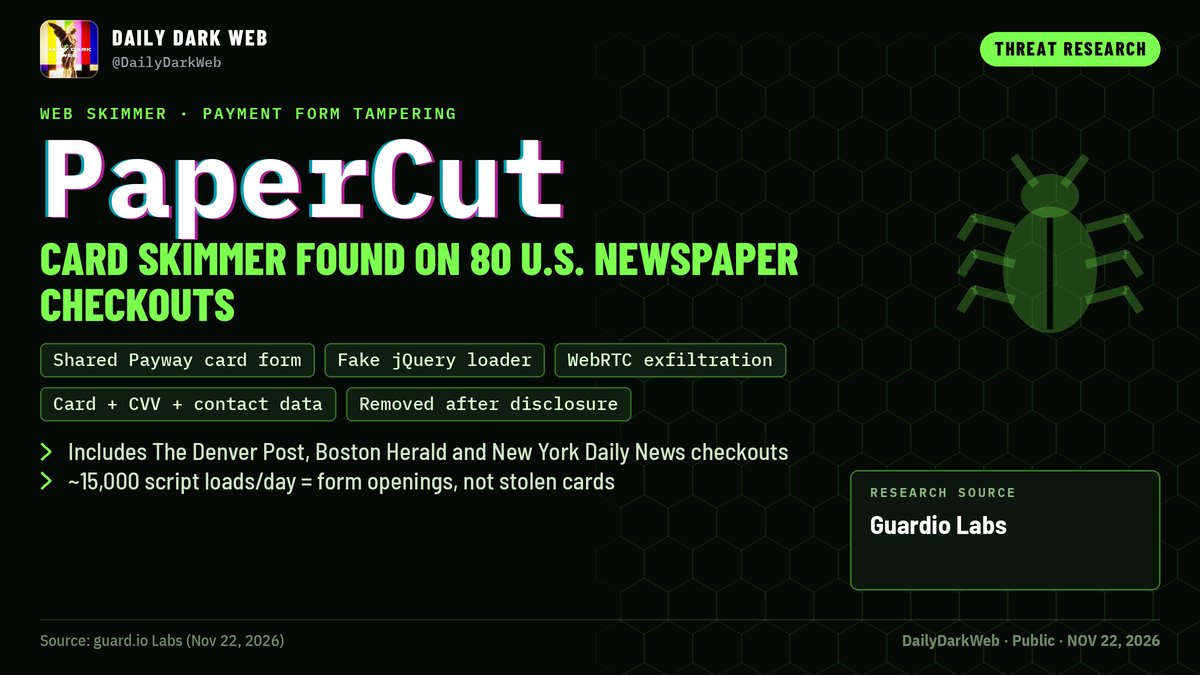
Here is the latest turn: the rogue line of code is gone. Guardio Labs, the security research team behind the finding, says a single malicious line sat inside a shared card payment form hosted by Payway, a company that runs checkout forms for news sites. About 80 U.S. newspaper checkouts used that form, The Denver Post, the Boston Herald and the New York Daily News among them. The line was removed after Guardio disclosed the case on Nov 22, and by the lab's account it had been live since Nov 13.DailyDarkWebx.com · DailyDarkWeb · xOpen original sourceSee in source list
What the code was built to take, and Guardio verified this by analyzing the code itself: card number, expiry date and CVV, the trio someone needs to spend your card online, plus name, email, phone number and address, the raw material for phishing. What Guardio did not see is any card actually being stolen. And that 15,000 a day figure you may run into counts form openings, not victims.DailyDarkWebx.com · DailyDarkWeb · xOpen original sourceSee in source list
What happened
Rewind to Nov 13, the day the trouble is said to have started. According to Guardio's research, someone tampered with the shared Payway form that day. Because dozens of newspapers point their checkout pages at that one hosted form, a change to it appeared everywhere at once, which is how a single edit came to touch about 80 newspaper checkouts, The Denver Post, the Boston Herald and the New York Daily News among them.DailyDarkWebx.com · DailyDarkWeb · xOpen original sourceSee in source listsite.guard.iosite.guard.io · rssOpen original sourceSee in source list
The mechanism Guardio documented is strikingly small. One added line of code loaded a file masquerading as jQuery, one of the most widely used JavaScript libraries on the web, and over WebRTC, the browser's built in channel for direct connections, it fetched the real payload: a card stealer built to copy whatever a shopper typed into the payment form.DailyDarkWebx.com · DailyDarkWeb · xOpen original sourceSee in source list
Guardio watched the setup from Nov 13 to Nov 19, then went public on Nov 22, 2026. The line was removed after the disclosure. The lab's bottom line is careful: it verified what the skimmer was built to collect, and it did not observe any card data being taken.DailyDarkWebx.com · DailyDarkWeb · xOpen original sourceSee in source listsite.guard.iosite.guard.io · rssOpen original sourceSee in source list
Why it matters
The shared form is what turns one line of code into a national story. Shoppers trust the newspaper brand on the page, the newspaper trusts Payway to handle the payment, and the skimmer sat exactly where those two chains of trust meet. A single change at the vendor level reached dozens of well known checkouts at once, which is the supply chain risk of modern web payments in miniature.DailyDarkWebx.com · DailyDarkWeb · xOpen original sourceSee in source list
The shopping list is the second reason to care. Card number, expiry and CVV open the door to direct card fraud, and the name, email, phone and address gathered alongside them are exactly what a convincing phishing email or call is made of, so the danger never had to stop at the checkout page. How far it actually went is the open question, because Guardio saw the capability, not the crime.DailyDarkWebx.com · DailyDarkWeb · xOpen original sourceSee in source list
What to do
If you paid by card at one of these newspaper checkouts on or after Nov 13, act now rather than later. Contact your card issuer, say you may have used the card at an affected checkout, and ask them to watch the account or issue a replacement. Check your statements for charges you do not recognize. And treat any email, text or call that mentions your card details or your newspaper subscription with suspicion, because that kind of follow up is the classic second act after a card grab.DailyDarkWebx.com · DailyDarkWeb · xOpen original sourceSee in source list
Confirmed and still uncertain
Settled, on the evidence so far: a malicious line existed in the shared Payway form, it loaded a fake jQuery file over WebRTC, it was built to capture card number, expiry, CVV, name, email, phone and address, it loaded roughly 15,000 times a day, and it was removed after the Nov 22 disclosure. Guardio verified each of those points through code analysis.DailyDarkWebx.com · DailyDarkWeb · xOpen original sourceSee in source listsite.guard.iosite.guard.io · rssOpen original sourceSee in source list
Unsettled: whether any card data was actually transmitted, how many shoppers typed payment details into the tampered form, who inserted the line, and how that person reached a form hosted by a payment vendor. Nothing in the disclosed research answers those questions, and the public discussion around it does not either, so the incident stands as an observed capability without an observed outcome.DailyDarkWebx.com · DailyDarkWeb · xOpen original sourceSee in source list
What people are saying
The conversation so far is a relay, not a debate. DailyDarkWeb, an X account that tracks web crime news, summarized the Guardio findings, flagged the 80 checkout count, the three big newspapers and the WebRTC delivery trick, repeated the advice to contact card issuers, and linked to the research post. In this batch, that summary is the vehicle for nearly every specific detail in circulation.DailyDarkWebx.com · DailyDarkWeb · xOpen original sourceSee in source list
Guardio Labs is the only substantive voice on the record. Its research note, which DailyDarkWeb links to and whose web address tags the case as 'papercut', is the origin of the timeline, the mechanism and the scope. No response from Payway, from any named newspaper, or from a card issuer appears in the available evidence, so the researchers' account currently stands alone.site.guard.iosite.guard.io · rssOpen original sourceSee in source listDailyDarkWebx.com · DailyDarkWeb · xOpen original sourceSee in source list
Evolution
The case moved through three beats. Between Nov 13 and Nov 19, Guardio's research window, the lab found and dissected the skimmer inside the shared form. On Nov 22 it published the findings. After that disclosure, the malicious line was removed, closing a window that had been open since Nov 13.DailyDarkWebx.com · DailyDarkWeb · xOpen original sourceSee in source listsite.guard.iosite.guard.io · rssOpen original sourceSee in source list
One correction has already entered the record. The roughly 15,000 daily figure is a count of script loads, meaning checkout form openings, not a count of stolen cards, and Guardio's stated position is that it did not observe card theft. On the evidence as it stands, this is a confirmed skimmer with an unknown outcome, not a confirmed breach.DailyDarkWebx.com · DailyDarkWeb · xOpen original sourceSee in source list
Reach
1 independent groups, 1 updates, and 1 engagements.
Technical detail
Under the hood, the whole thing is one line. That line, per Guardio's analysis, loaded a file dressed up as jQuery, the JavaScript library that runs on a huge share of the web, and the file pulled the real payload over WebRTC, the browser's built in system for direct peer to peer audio, video and data connections. The payload itself was a card stealer.DailyDarkWebx.com · DailyDarkWeb · xOpen original sourceSee in source list
The collection list, verified in the code: card number, expiry date and CVV, the combination that enables card not present fraud, meaning charges made online or by phone without the physical card, plus name, email, phone number and address. Guardio is explicit about the boundary here. It confirmed what the code was built to collect, and it observed no transmission of that data.DailyDarkWebx.com · DailyDarkWeb · xOpen original sourceSee in source list
Sources and evidence
The evidence base is two items. The primary source is Guardio Labs' research post on its own site, whose address labels the case 'papercut' and reads, in effect, that 80 U.S. newspaper websites served a credit card stealer. The second is DailyDarkWeb's post on X, which summarizes that research, links to it, and carries the specifics available here, from the field list and the dates to the 15,000 clarification.site.guard.iosite.guard.io · rssOpen original sourceSee in source listDailyDarkWebx.com · DailyDarkWeb · xOpen original sourceSee in source list
Two limits come with that. The research post reached this batch as a link without its body text, so every detail quoted above travels through the DailyDarkWeb summary rather than through the note itself. And both items lead back to a single research team: no independent confirmation from Payway, the newspapers or the card networks appears anywhere in the batch, and no victim report tied to this skimmer appears in it either.site.guard.iosite.guard.io · rssOpen original sourceSee in source listDailyDarkWebx.com · DailyDarkWeb · xOpen original sourceSee in source list
Sources
- DailyDarkWebx.com · DailyDarkWeb · x
- site.guard.iosite.guard.io · rss